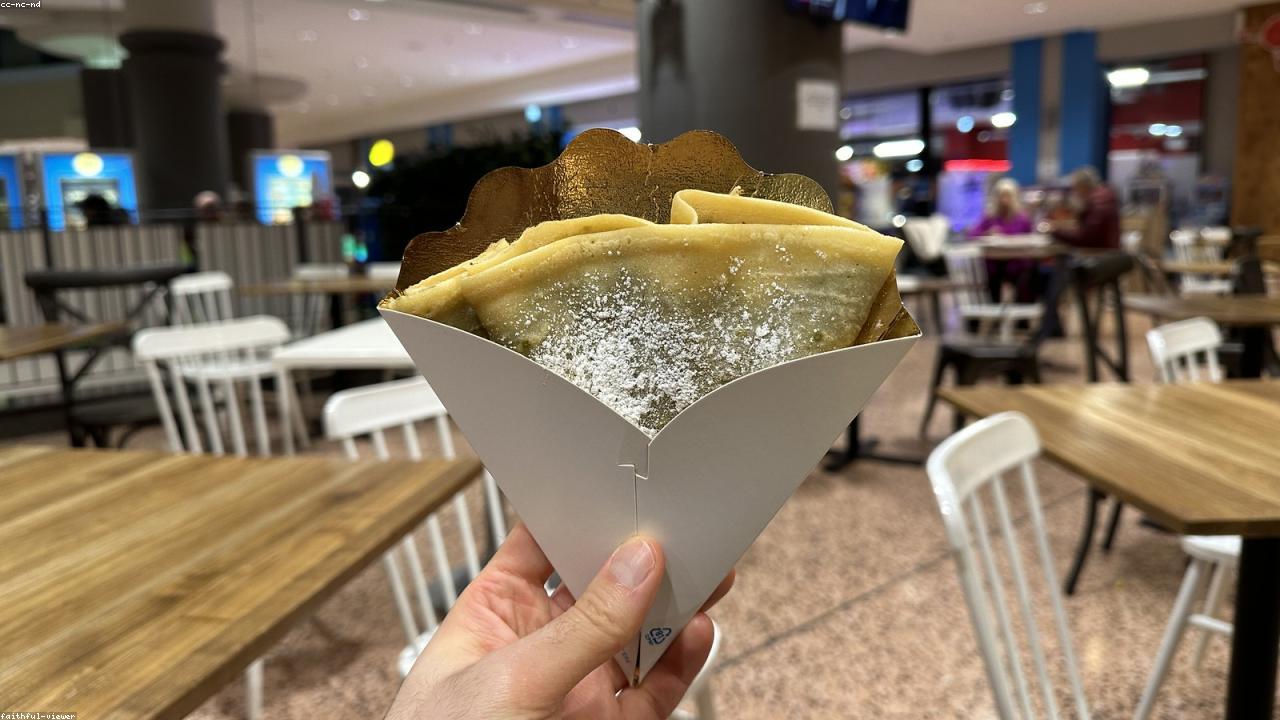
The mille crêpe is a cake built entirely without an oven. In place of sponge it uses a tall stack of crêpes — often around twenty, each cooked paper-thin — glued together with a thin film of cream. Cut into it and you see the appeal at once: dozens of fine horizontal stripes, alternating golden crêpe and pale cream, like the growth rings of a very buttery tree.
Its name is French — mille crêpe means "thousand crêpes" — but the cake most people picture today owes its fame to Japan, where patisserie culture refined it into the delicate, lightly sweet showpiece now sold in cake counters from Tokyo to New York.
What a mille crêpe actually is
Strip away the romance and a mille crêpe is a simple idea executed with obsessive patience. You make a large batch of thin crêpe batter, cook a tall pile of identical crêpes, let them cool, then build the cake one crêpe at a time — spreading a restrained layer of cream over each before laying down the next.
The "thousand" of the name is poetic licence; a typical cake has around twenty layers, though showpiece versions push well beyond that. What matters is not the exact count but the ratio: the crêpes must be thin enough, and the cream sparse enough, that no single layer dominates. Get it right and a forkful tastes less like crêpe-and-cream and more like a single, melting whole.
A French name, a global revival via Japan
Layered crêpe cakes have deep roots in French home and restaurant cooking — the gâteau de crêpes is an old, unfussy idea. But the sleek, lightly sweetened mille crêpe that became an international cake-counter star is closely associated with Japan and the Japanese-influenced patisserie scene.
The dessert was carried into global fame by boutiques built around it — most famously Lady M, founded in New York with a strong Japanese aesthetic, and Japanese chains such as Paper-thin and Doutor-adjacent café culture that prize delicacy over richness. That sensibility — fewer grams of sugar, thinner crêpes, a cleaner finish — is what most people now mean when they say "mille crêpe," even though the words on the menu are French. We flag this honestly: the cake is a genuinely cross-cultural object, French in vocabulary and Japanese in the form that made it famous.
The cream: pastry cream, diplomat, or lightened custard
The filling is where a mille crêpe is won or lost. Because there is so little of it per layer, it has to be both flavourful and light enough to set without weighing the stack down. Most recipes reach for one of two custard-based creams:
- Crème pâtissière (pastry cream) — a cooked custard of milk, egg yolks, sugar and a thickener such as cornflour. Rich and stable, but on its own a touch heavy for twenty layers.
- Crème diplomate (diplomat cream) — pastry cream folded with whipped cream, sometimes set with a little gelatine. Lighter, airier and the classic choice for a mille crêpe because it holds its shape between thin crêpes without becoming dense.
Both are core members of the pastry-cream family. The cream is usually only lightly sweetened, letting the toasted, slightly eggy flavour of the crêpes come through.
Assembly: the patience tax
There is no shortcut. A mille crêpe is assembled the way a bricklayer builds a wall — one course at a time, each one flat and level.
- Cook uniform crêpes. Every crêpe should be the same diameter and thickness; uneven crêpes telegraph straight through the finished slice as wavy stripes.
- Cool completely. A warm crêpe melts the cream and the layers slide. Bakers stack and cool the crêpes fully before building.
- Spread thin and even. A small, consistent amount of cream per layer — too much and the cake bulges and weeps; too little and it tastes dry.
- Chill to set. The finished tower is refrigerated for several hours so the cream firms and the cake can be cut cleanly.
Because nothing is baked, the only leavening of flavour is care. This is a cake that rewards a steady hand far more than any clever ingredient.
Matcha, seasonal and flavoured towers
The plain vanilla mille crêpe is the baseline, but the format invites variation because both the crêpe and the cream can be tinted and flavoured:
- Matcha — green-tea powder whisked into the batter and the cream, giving the signature jade stripes and a gentle, grassy bitterness that offsets the sweetness. It is the defining Japanese-style variant.
- Chocolate & hojicha — cocoa crêpes, or roasted-tea creams, for a deeper, toastier profile.
- Seasonal fruit — strawberry, mango or yuzu folded into the cream, sometimes with a thin layer of fresh fruit between crêpes.
- Caramelised top — the uppermost crêpe dusted with sugar and brûléed for a crisp, glassy lid.
Slicing to show the stripes
Half the drama of a mille crêpe is visual, and that drama lives in the cut. A clean slice reveals the full ladder of layers; a torn one looks like a collapsed accordion.
- Chill first. A well-set, cold cake cuts cleanly; a room-temperature one smears.
- Use a thin, sharp knife. Warm the blade under hot water and wipe it dry between cuts so the cream releases instead of dragging.
- Press, do not saw. A single confident downward stroke keeps the stripes crisp and parallel.
Served on its side, a slice should stand up on the plate, its layers fanning like the pages of a book — the proof that the patience paid off.
Frequently asked questions
Is mille crêpe Japanese or French?add
Both threads run through it. The name and the underlying idea of a layered crêpe cake are French, but the sleek, lightly sweetened version that became globally popular is strongly associated with Japan and Japanese-influenced patisserie. It is best described as a French concept perfected and popularised through Japan.
How many layers does a mille crêpe have?add
Despite the name "thousand crêpes," a typical cake has around twenty crêpe layers. Some elaborate versions stack thirty or more, but the goal is balance — enough layers to create fine stripes without any one crêpe standing out.
Why is my mille crêpe sliding apart?add
Usually the crêpes were still warm during assembly, the cream layer was too thick, or the finished cake was not chilled long enough. Cool the crêpes completely, spread a thin even film of cream, and refrigerate the tower for several hours before slicing.
What cream is used in a mille crêpe cake?add
Most use diplomat cream — pastry cream lightened with whipped cream — because it is rich in flavour yet light enough not to crush the delicate layers. Plain pastry cream and lightly sweetened whipped custards are also common.